

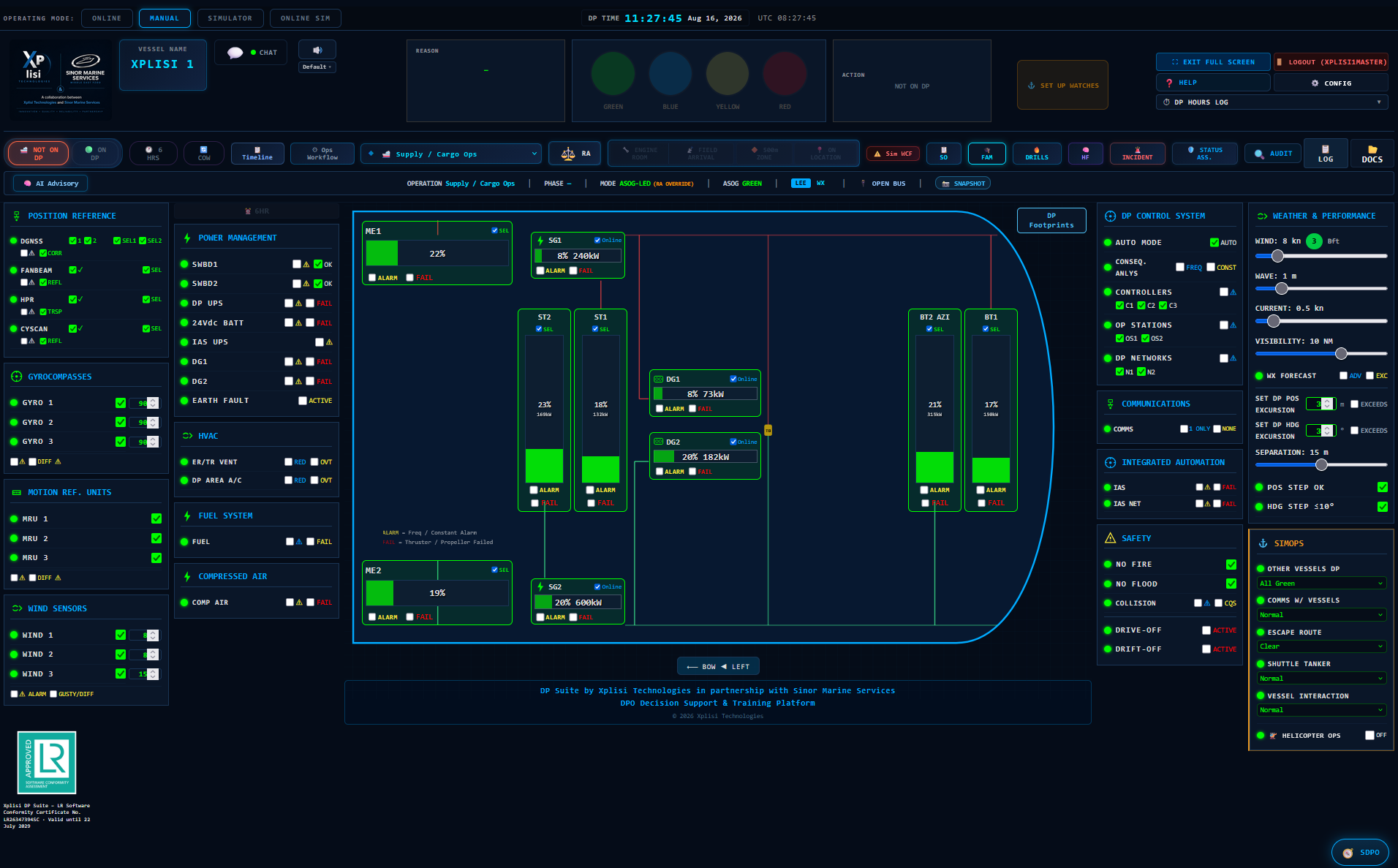
DP SUITE
Dynamic Positioning Operator Decision Support & Training Platform
Operational Intelligence for Safer DP Operations
Integrated with ERSUITE
English Version
Versão em português (Brasil)
Turn DP procedures, ASOG limits and emergency scenarios into clear, real-time operational guidance.
Certified Operational Intelligence for DP Operations
Xplisi DP Suite – LR Software Conformity Certificate No. LR26347394SC · Valid until 22 July 2029
Xplisi DP Suite is more than a digital ASOG or another monitoring screen. It is a Lloyd’s Register assessed decision-support platform designed to bring live operational assurance into DP operations.
The system continuously connects vessel condition, ASOG status, CAM/TAM mode, machinery availability, alarms, environmental limits, operational risk and crew actions into one clear and auditable operational picture.
DP Suite holds a Lloyd’s Register Software Conformity Certificate.
For vessel owners, this means a platform designed not only to support the DPO, but to strengthen operational control, reduce human-factor risk, protect machinery and provide objective evidence of how the vessel was operated.
From static procedures to live, verified operational assurance.
The platform is designed around three principles:
Deterministic
The same inputs produce the same operational assessment.
Configurable
The company and vessel control their own limits, thresholds and operational rules.
Auditable
Status changes, assessments, confirmations and operational actions are recorded and traceable.
DP Suite + ER Suite — One Integrated Operational Picture
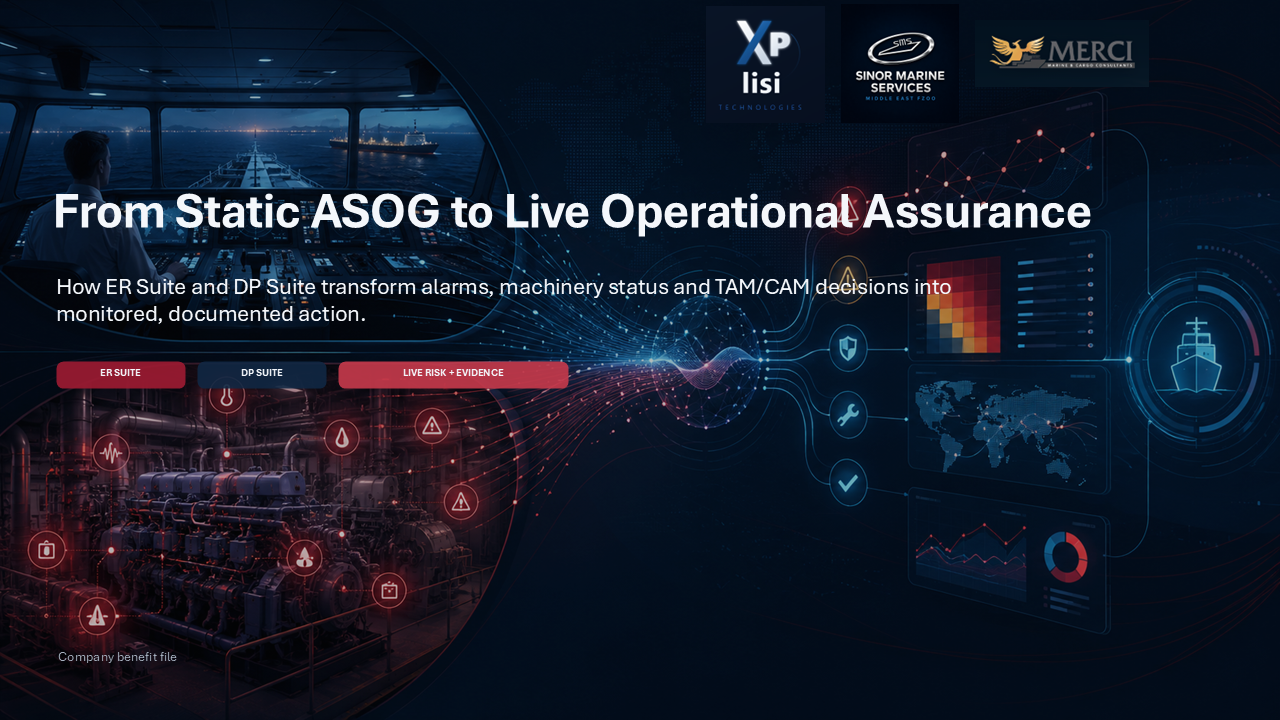
DP safety does not begin and end at the DP console.
A loss of propulsion, power, cooling, lubrication or supporting machinery can become a DP event long before the DPO fully understands its consequence.
When DP Suite is integrated with Xplisi ER Suite, the bridge no longer sees machinery alarms as isolated indications.
ER Suite interprets the machinery condition, criticality, recurrence, duration, redundancy and cascade effects. DP Suite then translates that information into its operational consequence for ASOG status, CAM/TAM mode, risk assessment and DP capability.
Engine Room Alarm → Machinery Meaning → Cascade Consequence → DP Impact → ASOG Status → Required Action → Evidence
This creates one live operational assurance layer connecting the Engine Room, the DP bridge and the shore office.
Instead of asking the DPO to mentally assemble information from separate systems, the platform presents the operational consequence in a structured form — while the final decision remains with the responsible crew.
Prevent High-Cost Incidents
Recognise degradation earlier, prevent normalisation of recurring faults and support the correct operational response before a manageable failure becomes a blackout, loss of position or major casualty.
Protect the Company With Evidence
Every status change, assessment, confirmation and operational decision can be recorded, giving the owner objective evidence for audits, charterer discussions, investigations and claims.
Move from daily reports and post-event explanations to live visibility of vessel status, ASOG condition, CAM/TAM mode, alarms, crew actions and decision history.
Give Shore Real Operational Control
Use CAM when the risk requires it and TAM when conditions genuinely permit it, reducing unnecessary machinery exposure without compromising the required safety posture
Protect the Asset
DP Suite helps vessel owners move from traditional vessel assurance to live operational assurance.
Reduce Human Error
Technical failures do not automatically become accidents.
Very often, the final outcome depends on whether the crew recognises the degradation early enough, understands its consequence, follows the correct procedure and takes the correct decision.
DP Suite helps reduce this risk by giving the DPO a clear and structured operational picture instead of leaving the operator to interpret multiple disconnected alarms under pressure.
The system supports the operator with:
live ASOG interpretation
structured risk assessment
CAM / TAM guidance
degraded-equipment awareness
operational limitations
required controls
checklist verification
escalation guidance
documented decision paths
The aim is not to replace the DPO.
The aim is to support the DPO with the combined operational picture that would otherwise need to be assembled mentally, often under time pressure
Continuous CAM / TAM Risk Control
Not every DP operation carries the same level of risk.
CAM provides the required conservative configuration for critical operations, but operating continuously in CAM where it is not required can expose generators, engines and thrusters to unnecessary running hours and additional wear.
DP Suite provides a structured and auditable framework for deciding when CAM is required and when TAM is acceptable.
The system continuously considers operational type, vessel condition, ASOG limits, equipment availability, weather, risk controls and crew confirmation.
If conditions deteriorate, the system can identify that TAM is no longer appropriate and support escalation to CAM.
If conditions later improve, the system can support a controlled return to TAM.
The objective is not to reduce safety. It is to match vessel configuration to the real operational risk while protecting the asset.
For shipowners, this can mean reduced unnecessary machinery exposure, improved reliability and better control of how the vessel is operated.
Live ASOG — Not a Static Document
Traditional ASOGs are essential, but they remain documents that the DPO must interpret manually during an operation.
DP Suite transforms the vessel's ASOG into a live operational framework.
The system continuously evaluates the vessel's actual condition and presents a four-colour status:
GREEN — Normal operation within approved limits.
BLUE — Informative or consultative condition requiring assessment, controls or increased monitoring.
YELLOW — Reduced capability or degraded condition requiring preparation to suspend or terminate the operation.
RED — Emergency or unacceptable condition requiring immediate action in accordance with vessel procedures.
The value is not simply the colour.
The value is understanding why the colour changed, which condition caused it, what capability is affected and what response is required.
Prevent the Normalisation of Degradation
One of the most dangerous patterns in complex vessel operations is the repeated alarm that gradually becomes accepted as normal.
A real DP3 closed-bus blackout case demonstrated exactly this problem: a recurring electrical condition appeared several times before the event, the vessel continued operating, the affected generator was repeatedly reconnected, and the fault eventually propagated through the 11 kV closed bus into a complete blackout and loss of position.
DP Suite is designed against this exact failure pattern.
It can track alarm recurrence and persistence over time so that repeated conditions are not simply acknowledged and forgotten.
A condition seen again and again can be escalated rather than normalised.
This gives the crew and shore management visibility of a developing problem before it becomes a casualty.
Decision Support With Verification
Automation is powerful — but no automated system should simply be assumed to have performed the expected protective action.
DP Suite supports a second layer of awareness.
For example, where the vessel's Power Management System is expected to open a bus tie following an electrical failure, the PMS performs the action.
DP Suite does not control the PMS.
Instead, it helps the crew verify that the required protective response actually occurred.
The bridge and engine room can be alerted, the change in configuration can be confirmed, and if the expected response did not occur, the crew can be prompted to take the required manual action in accordance with vessel procedures.
The PMS acts. DP Suite helps ensure the crew knows, verifies and closes the loop.
Bridge, Engine Room and Shore — One Operational Picture
DP operations are not managed by the DPO alone.
The bridge, engine room and shore management may all need to understand the operational consequence of a degraded condition.
DP Suite creates one consistent operational picture across the vessel and the office.
The shore team can understand:
vessel DP status
active ASOG condition
CAM / TAM mode
equipment degradation
alarms and failures
risk assessment status
crew response
checklist completion
operational decisions
activity history
The office does not need to watch every vessel continuously.
The platform supports exception-based fleet assurance: management can focus on the vessels whose operational condition has actually changed.
Machinery Protection and DP Reliability
A DP system may show a thruster, generator or main engine as a single equipment item.
In reality, every one of these systems is supported by multiple machinery components.
A propulsion train, for example, may involve gearboxes, lubrication systems, shafts, bearings, CPP systems and several other supporting components.
DP Suite, when integrated with the Xplisi ER Suite, can bring degraded machinery information into the DP operational picture.
This allows the vessel to understand not only that an alarm has occurred, but whether that alarm threatens propulsion, power generation, redundancy or station-keeping capability.
The objective is to recognise loss of redundancy before that redundancy is actually needed.
Closed Bus Operation — Controlled, Verified and Documented
Closed-bus operation can offer operational advantages where the vessel's FMEA, class approval and procedures permit it.
But it must only be used under the correct conditions.
DP Suite can support the required workflow before entering closed-bus operation and verify that the required confirmations, operational conditions and approvals are satisfied.
If a critical electrical condition develops, the system can support immediate awareness that the vessel must transition out of the closed-bus configuration.
Where closed-bus operation is not approved, an unexpected closed bus tie can be flagged and recorded.
This transforms closed-bus management from a static procedural requirement into a live operational control process.
Operational Evidence
After an incident, degradation or charterer dispute, one of the most difficult questions is often:
What actually happened, and what did the crew do?
DP Suite creates a structured, time-stamped activity trail showing:
what condition occurred
what ASOG status applied
what operational mode was selected
what risk assessment was performed
what controls were required
who confirmed the action
when the decision was taken
whether the operation continued, downgraded or stopped
when shore management was informed
This gives shipowners objective evidence instead of relying only on emails, recollection or post-event reports.
The same evidence can support internal review, charterer discussions, audits, investigations and operational learning.
Human Factor Control
DP safety depends on both machinery and people.
DP Suite extends beyond the DP console by supporting the wider operational readiness of the crew.
The platform can support:
DP familiarisation
DP emergency drills
bridge handover
DPO qualification checks
work and rest hour monitoring
fatigue/readiness checks
alcohol-test confirmation where required by company procedure
Master's Standing Orders
operational checklists
DP documentation control
automatic DP-hours recording
structured incident reporting
Traditional systems may prove that a checklist exists.
DP Suite aims to prove that the correct action was actually taken.
Training and Simulation
DP Suite can also operate as a training and simulation platform.
The same operational logic used onboard can be applied to drills, simulated failures and competence development.
This means trainees and experienced DPOs can practice:
ASOG interpretation
degraded conditions
CAM / TAM decisions
equipment failures
emergency response
loss of redundancy
operational escalation
checklist execution
bridge-engine room coordination
The objective is to train not only system familiarity, but decision-making.